Resilience
Protect continuity across supply, productive assets, processing, logistics and cash flow.
- Secure critical flows
- Protect productive capacity
- Recover operating performance

Resilience + Adaptation for agri-food value chains
ReAd mobilises intelligence, strategy, partnerships, venture building and capital pathways for the systems that produce, transform and move food.
Built with corporate leaders, investors, entrepreneurs, scientists, technology providers and institutions.
 System brief / 01
One economic agenda
Food systems need the strength to absorb disruption and the capacity to evolve as climate, resources, technologies, geographies and markets change.
Protect continuity across supply, productive assets, processing, logistics and cash flow.
Renew sourcing, technology, infrastructure and business models for changing conditions.
Resilience protects value.Adaptation creates future value.
The economic case
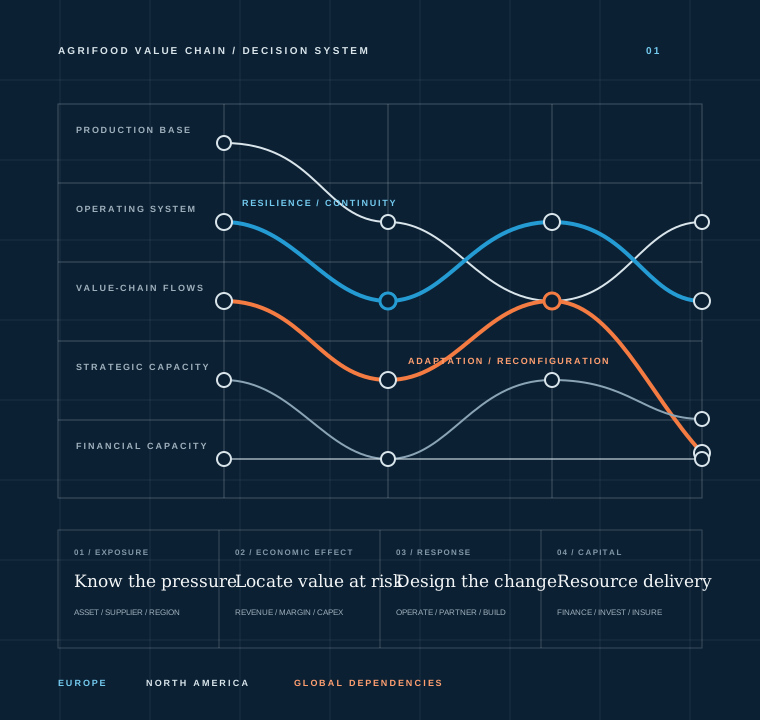
Resilience reaches across productive assets, industrial capacity, commercial flows and financial capacity. Each layer carries a distinct route to revenue, margin and long-term competitiveness.
Land, water, biological assets, yield and quality
Revenue continuityInputs, people, energy, processing and storage
Margin and asset productivitySourcing, cold chain, logistics and market access
Service level and working capitalData, technology, partnerships and operating options
Speed of adaptationCapex, insurance, liquidity and investability
Cost of risk and capitalRegional exposure view
Strategic exposureHighStructural + cross-border
€531.9bnEU agricultural output, 2024
28%EU territory affected by seasonal water scarcity, 2023
Water, heat, production conditions and infrastructure interact with a highly connected industrial and trade system. Southern exposure is especially concentrated, while sourcing and market dependencies cross borders.
Strategic exposureHighConcentrated + event-driven
US$1.537tnUS agriculture, food and related GDP, 2023
>50%US crop sales from farms with irrigation, 2022
C$149.2bnCanadian agriculture and agri-food GDP, 2024
Production concentration, irrigation dependence and high-value infrastructure create material transmission pathways. Drought, heat, wildfire, storms and floods can move rapidly through processing, logistics and markets.
Reading the exposure level. High is a qualitative regional screen across economic value, concentration, physical dependency, transmission pathways and adaptive capacity. Asset-level calibration is required for probability and financial loss. Sources: Eurostat, European Environment Agency, USDA Economic Research Service, USDA irrigation evidence and Agriculture and Agri-Food Canada.
Partnership at decision level
ReAd works alongside leadership teams, operators, investors, entrepreneurs and technical experts. The partnership connects evidence with ownership, resources and an executable path.
01Which revenue, margin and assets depend on exposed nodes?
02Which measures protect continuity and productive capacity?
03Where can adaptation create a durable advantage?
04Which capabilities belong inside the company and which require partners?
05Which capital pathway makes implementation viable?
One connected platform
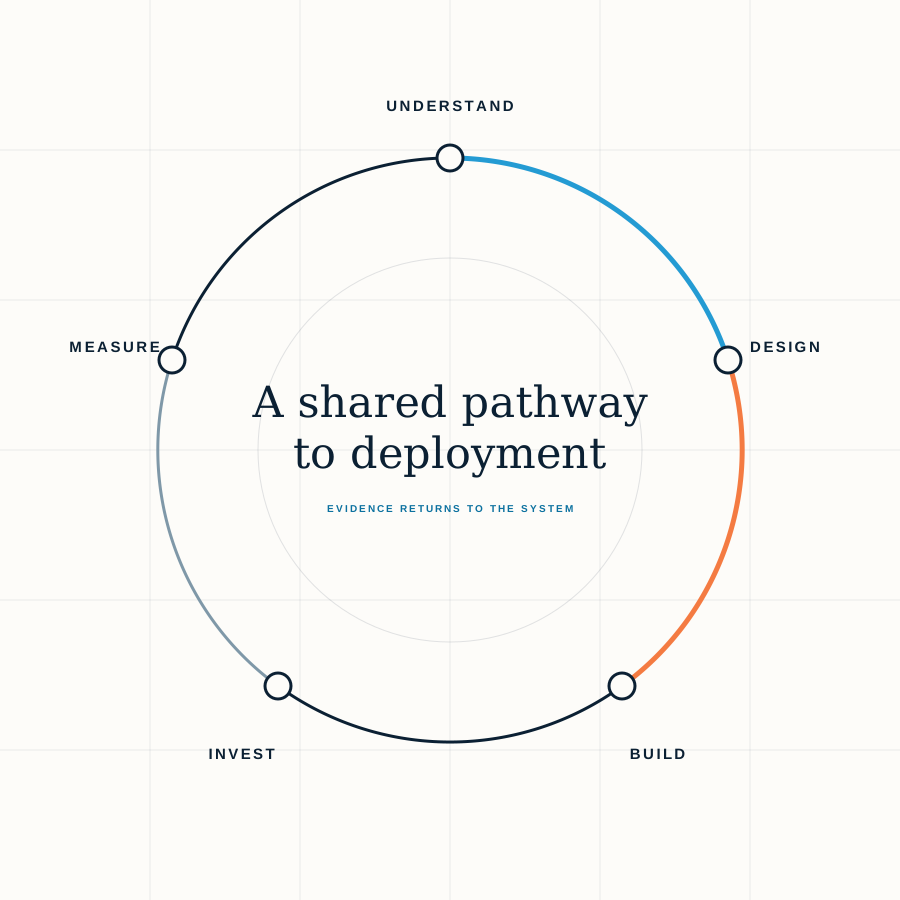
Four activities create a continuous route from understanding change to building and financing the response.
Connect physical, biological, operational and market signals to decision-relevant exposure, vulnerability and opportunity.
02Turn evidence into priorities, business cases, operating choices, partnerships and implementation pathways.
03Qualify material unmet needs, assemble the right partners and build scalable responses where the evidence supports a venture.
04Develop an investment pathway for scalable businesses, technologies, projects and infrastructure aligned with system needs.
Where we engage
Water, soil, genetics, biological solutions, production methods, automation and controlled environments.
Processing, ingredients, energy and resource efficiency, manufacturing continuity and flexible capacity.
Sourcing, storage, cold chain, logistics, trade corridors and diversification of supply.
Risk intelligence, decision tools, insurance, financing, adaptation planning and capital allocation.
ReAd convenes the capabilities each decision requires: operating knowledge, science, technology, entrepreneurship and capital.
Open to corporate, investment, technology, research and institutional partnerships
Start with a decision